

AI Doctor–Patient Chat & Visit Summary
-
Home
-
AI Doctor–Patient Chat & Visit Summary

AI Doctor–Patient Chat & Visit Summary
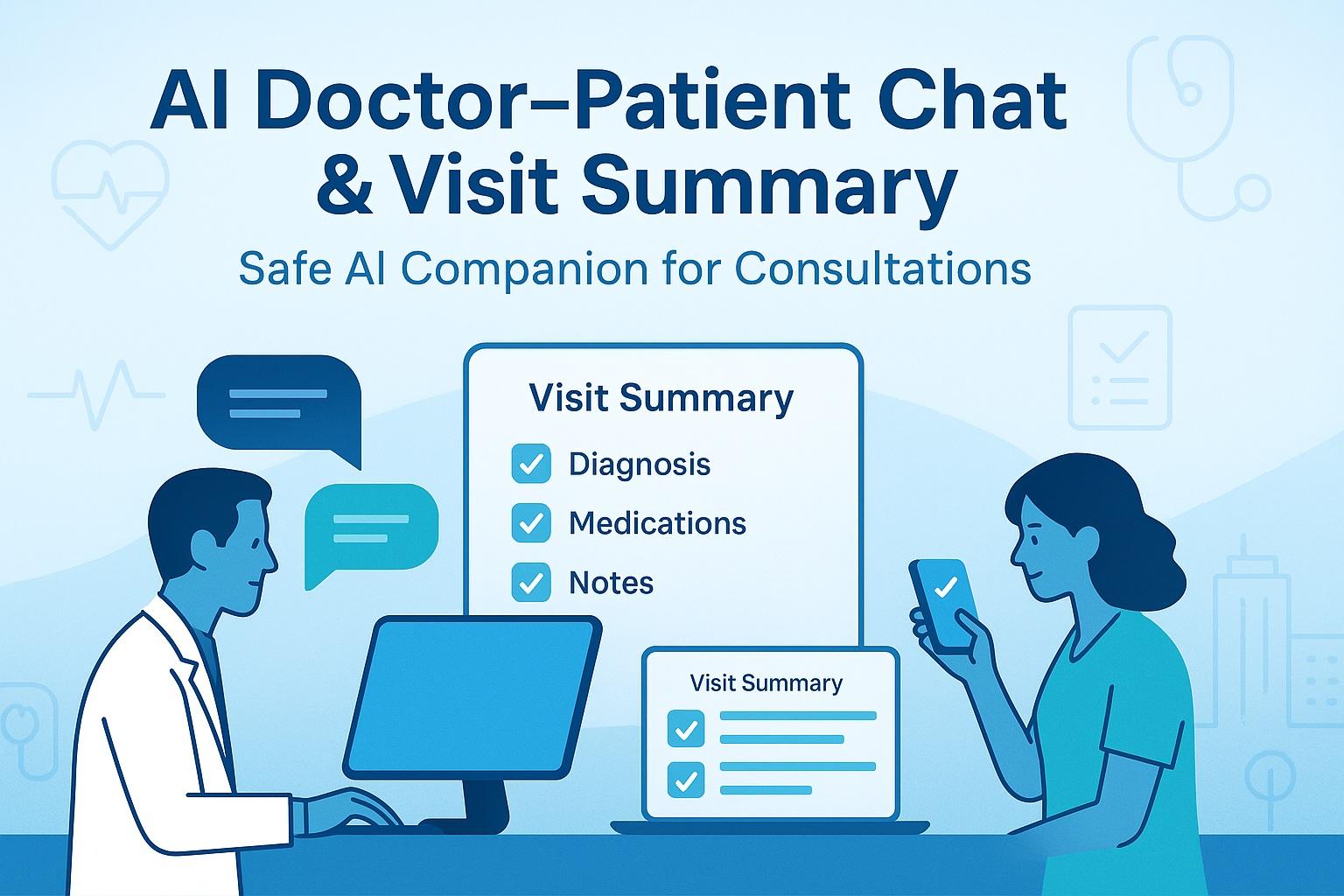
AI Doctor–Patient Chat & Visit Summary — Safe AI Companion for Consultations AI Doctor–Patient Chat & Visit Summary is a secure conversational layer for clinics and hospitals. It collects patient concerns before the visit, assists during consultations, and generates structured visit summaries and follow-ups—without replacing clinical judgment.
What is AI Doctor–Patient Chat & Visit Summary?
AI Doctor–Patient Chat & Visit Summary is a clinical messaging and documentation assistant for ambulatory and hospital settings. Patients can chat in simple language before and after visits; clinicians receive clean, structured summaries inside their EMR; and both sides get clear, human-readable visit overviews. The system is designed as “assistive AI”: it helps doctors think faster and document better, but never makes final diagnoses or orders.
Core use cases
- Pre-visit intake and triage questionnaires for online and in-person appointments
- Patient Q&A channel for non-emergency issues, with AI-drafted but clinician-approved replies
- Real-time consultation note assistant that transforms free text or transcripts into structured notes
- Auto-generated visit summaries and instructions for patients (after clinician review)
- Post-visit follow-up prompts, reminders, and symptom check-ins
Key modules
- Patient Chat Interface
Mobile-friendly chat for web, Android, and iOS; supports text, simple forms, and basic image/file upload (e.g., lab reports). - Triage & Intake Flows
Symptom-guided questionnaires tailored by specialty (e.g., pediatrics, internal medicine, dermatology), with red-flag questions surfaced to clinicians. - Clinician Console
Unified inbox of conversations, suggested replies, flagged risks, and AI-generated summaries mapped to the current encounter. - Visit Note Builder
Converts chat + clinician input into structured notes (SOAP / problem-oriented), ready to be pasted or synced into the EMR before signing. - Patient Visit Summary Generator
Produces plain-language summaries that explain what happened, what to watch for, and which medications/tests were agreed on. - Task & Reminder Engine
Follow-up tasks (e.g., “repeat labs”, “return in 3 months”) and automated but configurable patient reminders.
AI capabilities
- Symptom Intake & Normalisation
Transforms patient’s free-text descriptions into standardized symptom lists with onset, severity, and associated factors for clinician review. - Draft Responses for Clinicians
Suggests responses to patient questions (education, next steps, administrative issues); clinicians edit and approve before sending. - Real-Time Note Drafting
Builds a draft visit note from chat context, typed notes, or optional consultation transcripts, including history, exam, assessment, and plan. - Clinical Highlighting
Highlights red-flag statements, medication conflicts described by the patient, or follow-up gaps for clinicians to double-check. - Language Simplification for Patients
Converts clinical wording into understandable patient language without changing the medical meaning. - Continuous Learning (Configurable)
Models can be tuned on local templates and phrasing preferences while respecting data-governance rules.
Safety, ethics & medical boundaries
- AI never sends clinical conclusions to patients without clinician approval.
- No automated diagnosis, prescribing, or triage that bypasses human review.
- Configurable guardrails to prevent answers to emergency scenarios; instead, patients are directed to urgent/emergency care instructions.
- Clear labeling of AI-generated text for both clinicians and, where desired, patients.
Analytics & reporting
- Engagement Metrics
Number of chats, response times, pre-visit form completion, and patient portal activation. - Clinical Documentation KPIs
Average note completion time, reduction in documentation burden, and adoption rates by specialty or provider. - Quality & Safety Indicators
Patterns of unresolved messages, escalation rates, and common topics that may indicate service gaps or education needs. - Operational Impact
No-show reduction from pre-visit engagement, visit length changes, and throughput in busy clinics. - Export & APIs
Aggregated data export and APIs for analytics platforms and quality-improvement teams.
Integrations across ZPlatform Health
- Clinic Management & Patient Portal (SaaS)
Shared identity, appointments, and messaging threads accessible from the clinic portal. - Health Information System (Hospital Management)
Linking chats and summaries to encounters, MRN, and provider IDs. - Payments & Billing
Optional linkage to billing logic for teleconsults, e-visits, and paid follow-up messaging. - Third-Party Channels
Connectors (where allowed) for SMS, WhatsApp-style messaging, or custom mobile apps while keeping PHI server-side.
Security, privacy & compliance
- End-to-end encryption in transit and encryption at rest for all health data.
- Strong authentication and device/session controls for clinicians and patients.
- Role-based access so only authorized staff see specific conversations and summaries.
- Full audit trails of message edits, AI suggestions, clinician approvals, and note finalization.
- Configurable data-retention and de-identification options for model improvement and analytics.
Accessibility & localization
- Fully supports FA/EN and RTL layouts; extendable to more languages.
- AI can translate between patient and clinician languages while preserving medical terminology.
- Mobile-first UX for patients with low bandwidth and mid-range devices.
- Clear, large typography and simple flows suitable for older or less tech-savvy users.
Architecture & scalability
- Cloud-native microservices that separate chat, AI processing, and integration layers.
- Horizontal scaling for high-volume clinics, hospitals, and telehealth networks.
- API-first design so partners can embed chat and summary widgets in their own portals and apps.
- Options for SaaS, private cloud, or on-prem deployments depending on regulatory needs.
Implementation & support
- Blueprint configurations for common specialties (family medicine, pediatrics, internal medicine, psychiatry, etc.).
- Integration kits for major EMR/HIS and clinic systems (using standard APIs or file-based bridges).
- Training for clinicians on safe use of AI, supervision patterns, and documentation workflows.
- Support tiers from standard business-hours to extended or 24/7 for large health systems.
Pricing & licensing (example)
- Per-provider or per-seat subscriptions for clinics and hospitals.
- Volume-based pricing for networks or multi-site providers.
- Optional add-ons for advanced analytics, speech-to-text consultation capture, or deep EMR integrations.
- Pilot and phased-rollout options to prove value before full deployment.
Who uses AI Doctor–Patient Chat & Visit Summary?
- Outpatient clinics and group practices wanting lighter documentation load.
- Hospital outpatient departments and specialty centers.
- Telemedicine providers offering chat-based or hybrid visits.
- Corporate and occupational health services that need structured but fast encounters.
- Health systems standardizing documentation quality across many clinicians.
Why AI Doctor–Patient Chat & Visit Summary?
- Cuts documentation time while improving note quality and consistency.
- Keeps clinicians fully in control of medical decisions and patient communication.
- Engages patients before and after visits, improving understanding and adherence.
- Localized for FA/EN, RTL, and regional workflows while remaining enterprise-grade.
- Integrates seamlessly with the ZPlatform health stack and existing EMR/HIS systems.
Share this service:
Providing the Ultimate Experience in Financial Services

+98 905 752 3103