

Health Information System (Hospital Management)
-
Home
-
Health Information System (Hospital Management)

Health Information System (Hospital Management)
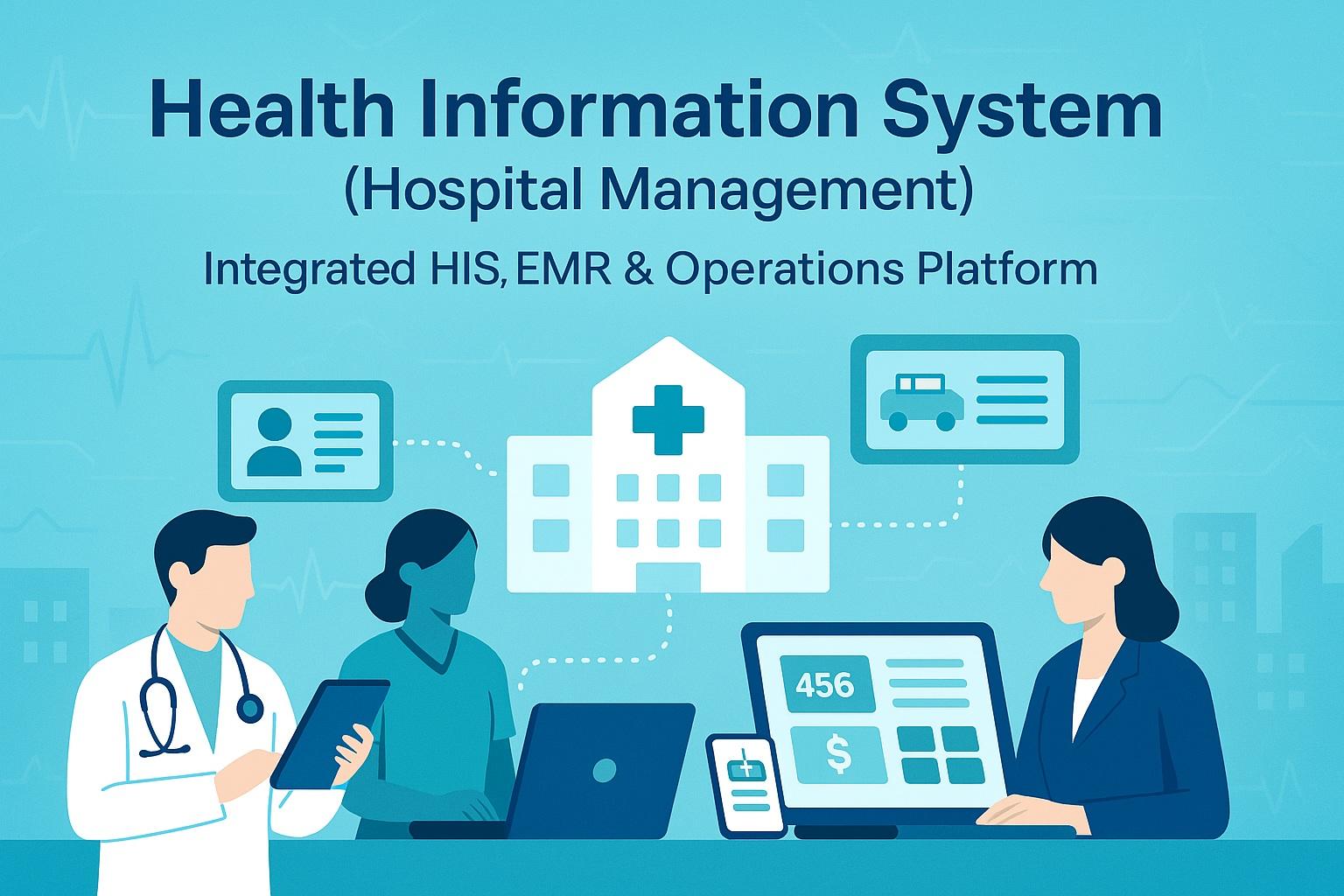
Health Information System (Hospital Management) — Integrated HIS, EMR & Operations Platform Health Information System is an end-to-end HIS and EMR platform for hospitals, clinics, and health networks. It unifies patient records, clinical workflows, billing, pharmacy, labs, radiology, and analytics into one secure, AI-enhanced system, localized for FA/EN and RTL,deployable on-prem or cloud.
What is Health Information System (Hospital Management)?
Health Information System (Hospital Management) is a comprehensive hospital information and operations platform that connects clinical, administrative, and financial workflows. From patient registration to discharge, labs, radiology, pharmacy, and insurance billing, all data lives in a single, integrated system.
It is built for public and private hospitals, specialty centers, networks, and day-care clinics. The platform supports inpatient, outpatient, emergency, and ancillary services, while providing management with real-time visibility into beds, resources, costs, and quality indicators.
Core modules
- Patient Registration & Demographics
Central MRN, smart search, national ID linkage, insurance details, and visit history. - Outpatient & Appointment Management
Multi-clinic scheduling, waiting-room queues, no-show tracking, and referral management. - Inpatient & Bed Management
Admission, transfer, discharge, bed occupancy views, ward dashboards, and length-of-stay indicators. - Electronic Medical Record (EMR)
Problem lists, allergies, vitals, progress notes, medication charts, nursing assessments, care plans, and orders. - CPOE & Medication Management
Computerized provider order entry for labs, radiology, procedures, and medications with checks for interactions and allergies. - Laboratory Information System (LIS)
Test ordering, sample tracking, analyzers integration, result validation, and structured result reporting. - Radiology Information System (RIS) & PACS Integration
Imaging requests, scheduling, protocols, reporting templates, and links to PACS for image viewing. - Pharmacy & Inventory
Drug formulary, stock control, automated issue/return, expiries, procurement support, and unit-dose options. - Billing, Tariffs & Insurance Claims
Charge capture, package management, payer contracts, electronic claims, denials management, and receivables tracking. - Emergency Department Flow
Triage, tracking board, time-stamped events, and handover documentation. - Administrative & HR Hooks
Basic rostering hooks, role management, and links to HR/payroll systems where integrated.
AI capabilities
- Clinical Documentation Assistant
Suggests note templates, summarizes previous encounters, and helps structure problem-oriented records for clinician review. - Coding & Grouping Support
Recommends ICD/diagnosis and procedure codes based on documentation, helping coders validate and speed up coding. - Risk & Triage Signals
Uses available data to flag at-risk patients (e.g., potential deterioration, readmission risk) for clinician review, not as a final decision. - Operational Forecasting
Predicts bed occupancy, ED load, and OR utilization to support staffing and scheduling decisions. - Fraud, Waste & Abuse Indicators
Detects unusual billing patterns, repeated tests, and outlier behaviors for audit teams to review. - Analytics Copilot
Natural-language queries like “Show average length of stay in internal medicine last quarter” converted into charts and tables.
Analytics & reporting
- Clinical Dashboards
Admissions, discharges, LOS, readmissions, infection trends, and basic quality indicators. - Operational & Capacity Views
Bed occupancy, OR utilization, clinic throughput, and waiting times by department and service line. - Financial & Revenue Cycle Analytics
Billing, collections, payer mix, denials, claim turnaround time, and profitability by service. - Regulatory & Accreditation Reports
Configurable templates aligned with national reporting formats and hospital accreditation requirements. - Data Access & Export
Scheduled reports, CSV exports, and APIs/webhooks to feed external BI and data warehouses.
Integrations & standards
- EMR/HIS Ecosystem
Works as the core hospital platform, with APIs that allow connection to external specialty systems when needed. - Lab, Radiology & Devices
HL7-style messaging and device interfaces to analyzers, imaging systems, vital-sign monitors, and PACS. - Insurance & E-Claims
Integration points for electronic claims, eligibility checks, and remittance advice where payers support it. - Government & Registries
Hooks for national health IDs, registries, and mandatory reporting where applicable. - Identity & SSO
Supports SSO, directory integration, and granular role-based access control.
Security, privacy & compliance
- Patient Data Protection
Encryption in transit and at rest, strong authentication, access logs, and configurable data-access policies. - Role-Based Permissions
Fine-grained control over who can see or edit clinical, financial, or administrative records. - Audit Trails
Full audit history for record changes, orders, prescriptions, and access to sensitive data. - Compliance-Ready
Configurable to align with local health-data regulations and best-practice privacy principles. - Business Continuity
Redundant infrastructure, automated backups, and disaster-recovery options for hospital-grade uptime.
Accessibility & localization
- Bilingual & RTL Support
Fully supports Persian (RTL) and English, with the option to add other languages. - Local Clinical & Financial Logic
Local tariffs, insurance rules, calendars, numbering systems, and regulatory forms. - Inclusive UX
Clear, high-contrast screens, keyboard navigation, and clinically optimized layouts for busy environments.
Architecture & scalability
- Cloud-Ready & On-Prem Options
Deployable as SaaS, private cloud, or on-prem according to hospital and regulator requirements. - Modular Microservices
Separate services for EMR, billing, LIS, RIS, pharmacy, and analytics allow independent scaling. - High Performance for Busy Hospitals
Designed to support high concurrent use in EDs, clinics, OR, and wards without degradation. - Multi-Hospital & Network Support
Manages multiple facilities, sites, and organizations with shared or separated data as required.
Implementation & support
- Phased Rollout
Proven pathways for go-live by department (e.g., OPD, IPD, ED, labs) to reduce risk and change fatigue. - Data Migration
Tools and services for migrating patient master data, historical encounters, and basic financial data from legacy systems. - Training & Enablement
Role-based training for clinicians, nurses, reception, billing, IT, and management, plus online help. - Ongoing Support
Tiered SLAs, remote support, and optional on-site assistance for critical go-lives and upgrades.
Pricing & licensing (flexible)
- Per-Bed / Per-Facility Licensing
Pricing that can scale from small clinics to tertiary centers and hospital networks. - SaaS Subscriptions
Monthly or annual subscriptions for cloud deployments, with usage-based options. - Enterprise & Government Programs
Custom contracts and deployment models for health systems, ministries, and large private groups. - Optional Add-Ons
Advanced AI packs, additional analytics, specialty modules, and deep custom integrations.
Who uses Health Information System (Hospital Management)?
- General and specialty hospitals (public and private).
- Clinics and ambulatory care centers using shared EMR and billing.
- Multi-hospital networks and health groups needing unified data.
- Diagnostic and treatment centers integrated with hospital workflows.
- Regulators and oversight bodies consuming standardized reports.
Why Health Information System (Hospital Management)?
- Unifies clinical, operational, and financial data in a single platform.
- Reduces paperwork, duplicate data, and manual reconciliation.
- Adds AI-driven assistance while keeping clinicians in full control.
- Localized for FA/EN, RTL, and regional insurance and regulatory environments.
- Scales from single facilities to national or regional health programs.
- Integrates naturally with the broader ZPlatform ecosystem for finance, analytics, and other verticals.
Share this service:
Providing the Ultimate Experience in Financial Services

+98 905 752 3103